Accéder au contenu principal

IKRA - Russian eggplant caviar/Russian aubergine caviar

Someone was looking for a "soft aubergine/eggplant spread with tomatoes" and I knew exactly what they were talking about. There's a dish in Russia, our Eastern neighbour, which is called IKRA or fake caviar. I got this recipe from Russian friend Galina back in Edinburgh sometimes around 2000. Still makes a regular appearance in our kitchen.  It's lovely on a slice of toast, or as a condiment or spread on a mezze-table. Russian aubergine spread IKRA 1 large aubergine/eggplant 1 large onion 2 garlic cloves 2 tomatoes 1 Tbsp olive oil or vegetable oil 2 Tbsp white wine vinegar or lemon juice salt and freshly ground black pepper fresh parsley or dill Prick the aubergine with a fork here and there, then place into a preheated 200C/400F oven and bake for about 60 minutes, until fully cooked and slightly charred on the outside. Flip over once or twice during baking. Remove from the oven, let it cool. Then cul half lengthwise and scoop out the flesh. Place into a cutting b...
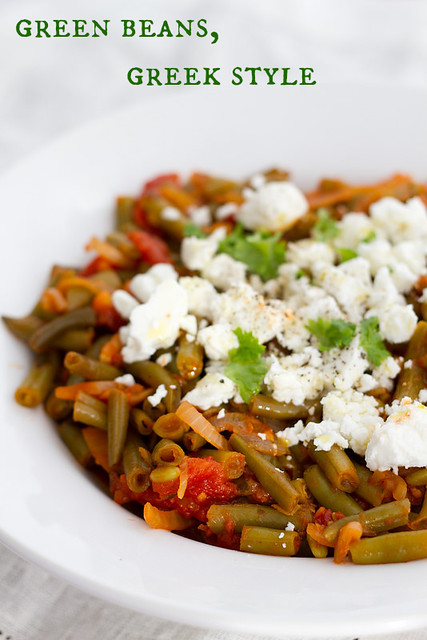
Green beans, Greek style

Green beans, Greek style

Today is the Greek independence day, commemorating the start of the War of Greek Independence back in 1821. I'm celebrating with sharing one of my favourite Greek dishes with you.

The recipe has been with me since early 1990s, and I remember clearly that I discovered it from a Finnish women's magazine. Cannot remember the exact date or the name of the magazine, but it was called "kreikkalainen papupata" or Greek bean stew. Since then - and that means for the last 20+ years - I've been making it every now and then. It's versatile - it's lovely when steaming hot, but also nice at room temperature and perfectly edible straight from the fridge. It goes equally well with some bread, or with a grilled steak, it can handle beer, water or wine. My kind of dish, you know :)

Green beans with tomatoes and feta
(Rohelised oad Kreeka moodi)
Serves 3 to 4 as a side dish, or 2 as a main dish

Kreeka oapada. Greek beans.

400 - 450 g frozen green beans, trimmed
2 large (red) onions, chopped
2-3 Tbsp olive oil
400 g canned chopped tomatoes
water
1-2 tsp dried Greek oregano
sea salt and freshly ground black pepper
fresh flat-leaf/Italian parsley, chopped

To serve:
about 100 g of Greek feta

(If using fresh beans, then trim them first, then boil in plenty of salted water for about 5 minutes. Discard the liquid).

Heat olive oil in a sauté pan. Add the onion and fry gently for about 5 minutes, until the onions start to soften. Don't burn them!

Add the tomatoes, the green beans and some water (I usually just fill the empty tomato tin with water). Season with salt, pepper and oregano. Bring to the boil, then reduce heat and simmer gently for about 20-25 minutes, until the beans are cooked and the tomato sauce thickened. Stir in the parsley.

Transfer the beans and tomato into a serving dish. Crumble some feta cheese on top.

Kreeka oapada. Greek beans.

Commentaires

Posts les plus consultés de ce blog

IKRA - Russian eggplant caviar/Russian aubergine caviar

Someone was looking for a "soft aubergine/eggplant spread with tomatoes" and I knew exactly what they were talking about. There's a dish in Russia, our Eastern neighbour, which is called IKRA or fake caviar. I got this recipe from Russian friend Galina back in Edinburgh sometimes around 2000. Still makes a regular appearance in our kitchen.  It's lovely on a slice of toast, or as a condiment or spread on a mezze-table. Russian aubergine spread IKRA 1 large aubergine/eggplant 1 large onion 2 garlic cloves 2 tomatoes 1 Tbsp olive oil or vegetable oil 2 Tbsp white wine vinegar or lemon juice salt and freshly ground black pepper fresh parsley or dill Prick the aubergine with a fork here and there, then place into a preheated 200C/400F oven and bake for about 60 minutes, until fully cooked and slightly charred on the outside. Flip over once or twice during baking. Remove from the oven, let it cool. Then cul half lengthwise and scoop out the flesh. Place into a cutting b...

It's not Pancake Day, it's Shrove Tuesday cream bun day soon ;)

Photo by Juta Kübarsepp for the March 2014 issue of Kodu ja Aed magazine.  It's time for semlor or lenten cream buns again soon - February 9th, to be precise. Remember, instead of pancakes, in Estonia and other Nordic countries cream-filled buns are eaten ( semlor in Swedish, vastlakuklid in Estonian, laskiaispulla in Finnish). I've got three different recipes here on Nami-Nami, all delicious :) Recipe for classic lenten buns Recipe for chocolate lenten buns Recipe for raspberry and marzipan lenten buns So, are you having pancakes or cream buns next week? ;)

Traditional Christmas roast (oven-baked pork shoulder with honey, mustard and rosemary)

From the recipe archives (originally posted in December 2012. Still my favourite Christmas roast). Photo by Juta Kübarsepp for the December issue of Kodu ja Aed magazine, 2012  What's your traditional Christmas roast (assuming you're eating meat)? Turkey? Goose? Duck? In Estonia it's definitely pork, though roast poultry has become more popular during recent years. I've been flirting with  roast goose  and actually served  duck leg confit  on Christmas Eve this year. It was delicious. However, for years I've been serving pork roast - a pork shoulder ( kaelakarbonaad in Estonian) in a mustard-honey-garlic-rosemary marinade, to be more precise. I love that it's a pretty fool-proof recipe, simple to make, with lots of flavour. And - as an added bonus - any leftovers are excellent on top of rye bread on the days after the party, or as part of a salad. So if you're not making it for a big family feast, you can still make the same amount and simply make sever...